Kilian Eng (1982)

Kilian Eng AKA DW Design was born in Stockholm, Sweden in 1982 where he still lives and works. In 2010 Kilian Eng graduated from Konstfack, University of Arts Craft & Design in Stockholm from the master group in storytelling, graphic design & Illustration. A couple of years ago Kilian discovered the possibilities of working in a digital way with illustration. Without losing respect for the powers of pen and paper Kilian started to investigate this new medium. The computer proved to be the perfect tool and gave exactly the kind of workflow he was looking for. 
Today Kilian Eng AKA DW Design is working digitally with almost every visual project making illustrations rich in colour and often with a lot of environment presented. In recent years he has also started to work with animation for telling stories. Since he often thinks in terms of a longer sequence when illustrating the many possibilities with moving image connected to storytelling has proven to be a great addition.
A big interest in Kilians work is to create alternative worlds, they can become visible just by opening a kitchen drawer or listening to the sound of cars on the street. Imagination can take over everywhere and be the starting point to create something unexpected. Much Inspiration comes from the interest in both classic and futuristic architecture, surrealism, science fiction, theater scenography, different elements and shapes in the nature as well as in the urban landscape.
Some Kilian clients include: Miami Horror, Frite Nite, Tesla Boy, Digital Arts, Acclaim Magazine, Acne Production, Playboy US, Eight Magazine, Kulturskolan Södertälje, Tokyo Dawn, The Sound Of Arrows and Lazer Sword.


Donato Giancola (1967)

Donato Giancola was born in Colchester, Vermont, USA in 1967. Since beginning his professional career in 1993, Donato's list of clients has grown to include major book publishers and collectors in New York to concept design firms on the West Coast: notables include The United Nations, LucasFilm, National Geographic, CNN, DC Comics, Microsoft, The Village Voice, Playboy Magazine, US Postal Service, Wizards of the Coast , Scholastic, Simon&Schuster, Tor Books, Random House, Time/Warner, The Scifi Channel, Milton-Bradley, and Hasbro. Merits range from the prestigious Hamilton King Award from the Society of Illustrators to nineteen Chesley Awards from the Association of Science Fiction and Fantasy Artists, three Artist Hugo Awards for outstanding professional work from the World Science Fiction Society, notable awards from the Art Renewal Center, and multiple silver and gold medals from the juried annual Spectrum: The Best of Contemporary Fantastic Art.


Juan Giménez López (1943)

Juan Giménez López was born in Mendoza, Argentina, in 1943. Fascinated since childhood by the drawing, he began imitating comics and Hispanic and Spanish books covers. Later he dedicated to drawing sequences of movies he liked, and even play them in clay. So he learned to draw narrative sequences. He completed his training studying Industrial Design.
He worked in several Argentine advertising agencies, learning to synthesize the narrative to the millimeter. In 1976, he performs the cartoo war omic As The Pique (Ace of Spades) with writer Ricardo Barreiro.
In the late seventies he moved to Europe, starting to draw cartoons for publishers. In 1979 published his first color album Estrella Negra (Blak Star). Then published Basura, Cuestión de Tiempo (Rubbish, Question of Time), whose script he also wrote, El Cuarto Poder (The Fourth Power), Leo Roa and  Juego Eterno (Eternal Game).
Currently he's living in Sitges (Spain) and collaborates with Alejandro Jodorowsky in the series La Casta de los Metabarones (The Caste of the Metabarons) (Jodorowsky is the writer), and a short film in preproduction.


Orlando Arocena

Orlando Arocena was born in United States. He's a Mexican-Cuban American artist specializing in digital illustration. The clean, angular nature of vector illustration lends itself to a certain sci-fi flavor that permeates throughout Arocena’s work. As a Pratt Institute graduate in design, orlando used his interest in art history and culture to inspire his work. Now, Orlado is a creative consultant working on some of the largest brands in the world.


Anton Fadeev aka "Shant" (1985)


Anton Fadeev "Shant" was born in Kamchatka, Russia, in 1985. He is a concept artist now working for video game industry.


Colin Geller

Colin Geller works in California, United States. He is a professional Concept Artist currently working at Insomniac Games. Colin has worked in the game industry creating concept art for game titles such as Ratchet and Clank: A Crack in Time, Overstrike and Resistance 3.


Daniel Dociu (1957)

Daniel Dociu was born in Cluj, Romania, in 1957. He is a video game art director and concept artist. He is the chief art director for NCsoft North America and also works for its subsidiary ArenaNet. He obtained his master's degree in industrial design at the Fine Arts Academy in Cluj in 1982. Throughout the decade, he taught at the academy as an assistant professor and later worked as a graphic designer in Athens, Greece, a product designer and a freelance artist. He moved to the United States in 1990. From 1992 to 2003, Dociu did work for various video game developers including Square, Electronic Arts, and Zipper Interactive.


Feng Zhu (1977)

Feng Zhu was born in California, United States, in 1977. He is a well-known concept artist who has done work for various Hollywood studios and game developers, including Electronic Arts, Blur Studio, Disney, Sierra, MTV, Universal, Industrial Light + Magic, and the Skywalker Ranch where he worked on Star Wars Episode III.
Besides his professional work, he has also been teaching at the Art Center College of Design in Pasadena and making Gnomon instructional DVDs.


Jong Won Park (1980)

Jong Won Park was born in Kang Nam-Gu, South Korea, in 1980. He is an illustrator and concept artist who works in the video game industry. Jong has created concept art for game titles such as Aion, Steel Dog and 4Story Online.


Virgil Finlay (1914 - 1971)

Virgil Warden Finlay was born in Rochester, New York, United States, in 1914. He was a pulp fantasy, science fiction and horror illustrator. While he worked in a range of media, from gouache to oils, Finlay specialized in, and became famous for, detailed pen-and-ink drawings accomplished with abundant stippling, cross-hatching, and scratchboard techniques. Despite the very labor-intensive and time-consuming nature of his specialty, Finlay created more than 2600 works of graphic art in his 35-year career.
The Science Fiction Hall of Fame inducted Finlay in 2012.


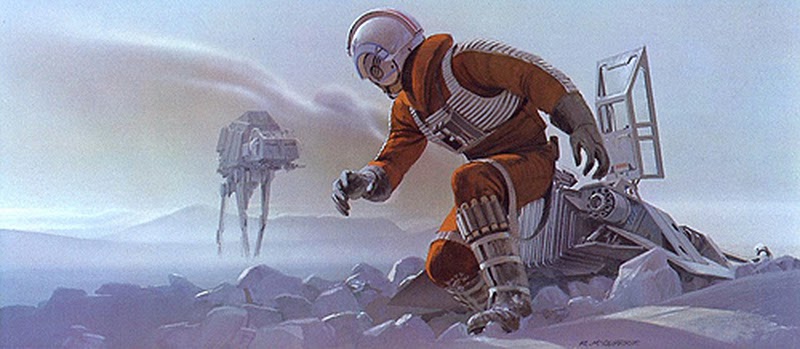
Ralph McQuarrie (1929 - 2012)

Ralph Angus McQuarrie was born in Gary, Indiana, United States, in 1929. He was a conceptual designer and illustrator who designed the original Star Wars trilogy, the original Battlestar Galactica TV series, E.T. the Extra-Terrestrial and Cocoon, for which he won an Academy Award, Close Encounters of the Third Kind,  Raiders of the Lost Ark and Star Trek IV: The Voyage Home.
McQuarrie worked as a technical illustrator for Boeing, as well as designing film posters and animating CBS News's coverage of the Apollo space program at the three-man company Reel Three.


Stanley Meltzoff (1917 - 2006)

Stanley Meltzoff was born in New York, United States, in 1917. He painted covers and interior spreads for the likes of Life, National Geographic, Saturday Evening Post, The Atlantic, and many others. His 65 covers for Scientific American was an indication of the good company that demanded his work. Today his art hangs in the National Gallery (Smithsonian), Getty Museum, and many other world-class institutions.
Bowing to the times, he switched gears and began painting saltwater game fish in their undersea environments.


Richard M. Powers (1921 - 1996)

Richard M. Powers was Born in Chicago, Illinois, United States, in 1921. He began by working in a conventional pulp paperback style, but quickly evolved a personal Surrealist idiom influenced by the cubists and surrealists, especially Picasso and Yves Tanguy. He also dabbled in abstract art and collage at a later age before dying in 1996 at the age of 75.
From the 1940s through the 1960s, he did many of covers for Doubleday. During the 1950s and 1960s, he served as an unofficial art director for Ballantine Books.


Ed Valigursky (1926 - 2009)

Edward Ignatius Valigursky was born in Arnold, Pennsylvania, United States in 1926. He studied at the Art Institute of Chicago on the G. I. Bill. He completed his studies at the Art Institute of Pittsburgh. He illustrated books for such publishers as Bantam Books, Ballantine Books, Lippincott, Macfadden Publications, and Time-Life Books. He illustrated science fiction novels by Isaac Asimov, Arthur C. Clarke, and Ray Bradbury.
In the 1970s he was invited to NASA to illustrate the spectacular space program for Popular Mechanics, where he continued to work until the 1980s.


Jim Burns (1948)

Jim Burns is a Welsh artist born in Cardiff, Wales, in 1948. He studied at Saint Martin's School of Art in London. When he left Saint Martin's in 1972 he had already joined the recently established illustration agency Young Artists. He has been with this agency, later renamed Arena, ever since.
He is today a contemporary British science fiction illustrator. His work mostly deals with science fiction with erotic overtones. His paintings are generally intricate photo-realistic works of beautiful women set against advanced machines and spaceships. While his preparatory sketches are more erotically focused, his final works and published book covers have a more academic tone portraying far off and imaginary worlds.


Peter Elson (1947 - 1998)

Peter Elson was born in Ealing, west London, in 1947. He was an English science fiction illustrator whose work appeared on the covers of numerous science fiction paperback novels, as well as in the Terran Trade Authority series of illustrated books. Elson, whose illustrations often placed detailed, brightly liveried spacecraft against vividly coloured backgrounds, influenced an entire generation of science fiction illustrators and concept artists.


Eddie Jones (1935 - 1999)

Eddie Jones was born in England in 1935. He was a science fiction illustrator, who started as a fan artist. He illustrated numerous science fiction book covers, some under the pseudonym S. Fantoni, and provided interior illustrations for books and magazines. Jones was active in the field from 1958 to 1989. In 1969, he became the art director for Visions of Tomorrow, a short-lived British SF magazine. The Science Fiction Writers of America described him as "the precursor to a generation of artists that helped define the look of early '70s SF illustration".


Hans Rudolf "Ruedi" Giger (1940 - 2014)

Hans Rudolf "Ruedi" Giger was born in 1940 in Chur, capital city of Graubünden, the largest and easternmost Swiss canton. Giger got his start with small ink drawings before progressing to oil paintings. For most of his career, Giger has worked predominantly in airbrush, creating monochromatic canvasses depicting surreal, nightmarish dreamscapes. However, he has now largely abandoned large airbrush works in favor of works with pastels, markers or ink. 
His most distinctive stylistic innovation is that of a representation of human bodies and machines in a cold, interconnected relationship, he described as "biomechanical". His paintings often display fetishistic sexual imagery.


Cory Jespersen

Cory Jespersen is a graphic designer and illustrator from Portland, Oregon, United States. For over 12 years, he’s run the gamut of clients, including Kroger, Fred Meyer, PetSmart, Person Group, and Audigy Group. His skill set is vast, but his greatest expertise revolves around the worlds of print design, environment design, brand identity, illustration, and digital media. His wish is to combine his knowledge and experience in these areas to deliver the best creative to Audigy Members and audiences.
Cory is also an award-winning illustrator and oil painter.


Paul Lehr (1930 - 1998)

Paul Lehr was born in White Plains, New York in 1930. He dominated science fiction covers in the mid-1960s into the 1970s. Lehr studied illustration at the prestigious Pratt Institute. He contributed significantly to the distinctively imaginative style of SF art during that era, which for some represents the peak of the form's long history. As American publishers came to prefer more realistic art in the 1980s, Lehr focused instead on covers for the sf magazines Analog, Omni, Tomorrow: Speculative Fiction, and Weird Tales as well as covers for foreign publishers.