Juan Giménez López (1943)

Juan Giménez López was born in Mendoza, Argentina, in 1943. Fascinated since childhood by the drawing, he began imitating comics and Hispanic and Spanish books covers. Later he dedicated to drawing sequences of movies he liked, and even play them in clay. So he learned to draw narrative sequences. He completed his training studying Industrial Design.
He worked in several Argentine advertising agencies, learning to synthesize the narrative to the millimeter. In 1976, he performs the cartoo war omic As The Pique (Ace of Spades) with writer Ricardo Barreiro.
In the late seventies he moved to Europe, starting to draw cartoons for publishers. In 1979 published his first color album Estrella Negra (Blak Star). Then published Basura, Cuestión de Tiempo (Rubbish, Question of Time), whose script he also wrote, El Cuarto Poder (The Fourth Power), Leo Roa and  Juego Eterno (Eternal Game).
Currently he's living in Sitges (Spain) and collaborates with Alejandro Jodorowsky in the series La Casta de los Metabarones (The Caste of the Metabarons) (Jodorowsky is the writer), and a short film in preproduction.


Terry Rodgers (1947)

Terry Rodgers was born in New Jersey, United States in 1947. He is known for his large scale canvases that focus on portraying contemporary body politics. He graduated cum laude from Amherst College in Massachusetts in 1969, with a major in Fine Arts. His strong interest in film and photography influenced his style in the direction of representational realism in art.


James Gurney (1958)

James Gurney was born in Glendale, California, United States in 1958. He is an artist and author best known for his illustrated book series Dinotopia, which is presented in the form of a 19th century explorer’s journal from an island utopia cohabited by humans and dinosaurs.
Gurney's freelance illustration career began in the 1980s, during which time he developed his characteristic realistic renderings of fantastic scenes, painted in oil using methods similar to the academic realists and Golden Age illustrators. He painted more than 70 covers for science fiction and fantasy paperback novels, and he created several stamp designs for the US Postal Service, most notably The World of Dinosaurs in 1996.


Ilya Yefimovich Repin (1844 - 1930)

Ilya Yefimovich Repin was born in Chuguyev, Russia, in 1844. He was a realist painter and the most renowned Russian artist of the 19th century. He played a major role in bringing Russian art into the mainstream of European culture. Repin persistently searched for new techniques and content to give his work more fulness and depth. His method was the reverse of impressionism. He produced works slowly and carefully. They were the result of close and detailed study. With some of his paintings, he made one hundred or more preliminary sketches.


Mort Künstler (1931)

Mort Künstler was born in Brooklyn, New York, United States in 1931. He is an American artist known for his illustrative paintings of the American Civil War. His works are primarily sold as mass-produced printed reproductions. Künstler is also known for earlier commercial illustration before turning to Civil War themes in the early 1980s, a body of work that dealt with America's national story: from portraits of prehistoric American life to the odyssey of the space shuttle. His work has also been published in illustrated books and magazines and used by advertising agencies.


Virgil Finlay (1914 - 1971)

Virgil Warden Finlay was born in Rochester, New York, United States, in 1914. He was a pulp fantasy, science fiction and horror illustrator. While he worked in a range of media, from gouache to oils, Finlay specialized in, and became famous for, detailed pen-and-ink drawings accomplished with abundant stippling, cross-hatching, and scratchboard techniques. Despite the very labor-intensive and time-consuming nature of his specialty, Finlay created more than 2600 works of graphic art in his 35-year career.
The Science Fiction Hall of Fame inducted Finlay in 2012.


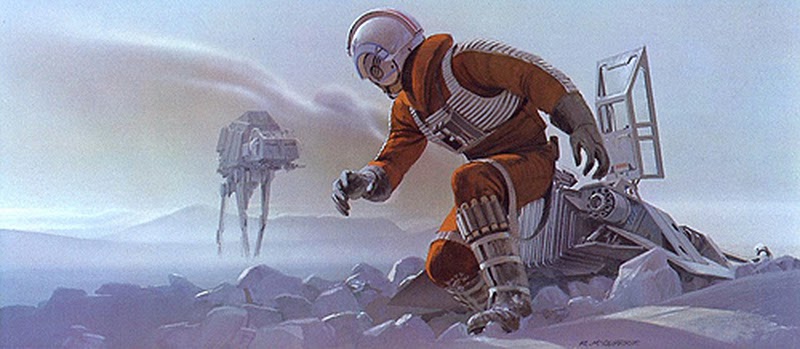
Ralph McQuarrie (1929 - 2012)

Ralph Angus McQuarrie was born in Gary, Indiana, United States, in 1929. He was a conceptual designer and illustrator who designed the original Star Wars trilogy, the original Battlestar Galactica TV series, E.T. the Extra-Terrestrial and Cocoon, for which he won an Academy Award, Close Encounters of the Third Kind,  Raiders of the Lost Ark and Star Trek IV: The Voyage Home.
McQuarrie worked as a technical illustrator for Boeing, as well as designing film posters and animating CBS News's coverage of the Apollo space program at the three-man company Reel Three.


Stanley Meltzoff (1917 - 2006)

Stanley Meltzoff was born in New York, United States, in 1917. He painted covers and interior spreads for the likes of Life, National Geographic, Saturday Evening Post, The Atlantic, and many others. His 65 covers for Scientific American was an indication of the good company that demanded his work. Today his art hangs in the National Gallery (Smithsonian), Getty Museum, and many other world-class institutions.
Bowing to the times, he switched gears and began painting saltwater game fish in their undersea environments.


Richard M. Powers (1921 - 1996)

Richard M. Powers was Born in Chicago, Illinois, United States, in 1921. He began by working in a conventional pulp paperback style, but quickly evolved a personal Surrealist idiom influenced by the cubists and surrealists, especially Picasso and Yves Tanguy. He also dabbled in abstract art and collage at a later age before dying in 1996 at the age of 75.
From the 1940s through the 1960s, he did many of covers for Doubleday. During the 1950s and 1960s, he served as an unofficial art director for Ballantine Books.


Michael Whelan (1950)

Michael Whelan was born in Culver City, California, United States, in 1950. He is an artist of imaginative realism. For more than 30 years he worked as an illustrator specializing in science fiction and fantasy cover art. Since the mid-1990s he has pursued a fine art career, selling non-commissioned paintings through galleries in the United States and through his website.
The Science Fiction Hall of Fame inducted Whelan in June 2009, the first living artist so honored. According to his Hall of Fame citation:
"Michael Whelan is one of the most important contemporary science fiction and fantasy artists, and certainly the most popular. His work was a dominant force in the transition of genre book covers away from the surrealism introduced in the 1950s and 1960s back to realism."


Ed Valigursky (1926 - 2009)

Edward Ignatius Valigursky was born in Arnold, Pennsylvania, United States in 1926. He studied at the Art Institute of Chicago on the G. I. Bill. He completed his studies at the Art Institute of Pittsburgh. He illustrated books for such publishers as Bantam Books, Ballantine Books, Lippincott, Macfadden Publications, and Time-Life Books. He illustrated science fiction novels by Isaac Asimov, Arthur C. Clarke, and Ray Bradbury.
In the 1970s he was invited to NASA to illustrate the spectacular space program for Popular Mechanics, where he continued to work until the 1980s.


Jim Burns (1948)

Jim Burns is a Welsh artist born in Cardiff, Wales, in 1948. He studied at Saint Martin's School of Art in London. When he left Saint Martin's in 1972 he had already joined the recently established illustration agency Young Artists. He has been with this agency, later renamed Arena, ever since.
He is today a contemporary British science fiction illustrator. His work mostly deals with science fiction with erotic overtones. His paintings are generally intricate photo-realistic works of beautiful women set against advanced machines and spaceships. While his preparatory sketches are more erotically focused, his final works and published book covers have a more academic tone portraying far off and imaginary worlds.


Peter Elson (1947 - 1998)

Peter Elson was born in Ealing, west London, in 1947. He was an English science fiction illustrator whose work appeared on the covers of numerous science fiction paperback novels, as well as in the Terran Trade Authority series of illustrated books. Elson, whose illustrations often placed detailed, brightly liveried spacecraft against vividly coloured backgrounds, influenced an entire generation of science fiction illustrators and concept artists.


Eddie Jones (1935 - 1999)

Eddie Jones was born in England in 1935. He was a science fiction illustrator, who started as a fan artist. He illustrated numerous science fiction book covers, some under the pseudonym S. Fantoni, and provided interior illustrations for books and magazines. Jones was active in the field from 1958 to 1989. In 1969, he became the art director for Visions of Tomorrow, a short-lived British SF magazine. The Science Fiction Writers of America described him as "the precursor to a generation of artists that helped define the look of early '70s SF illustration".


Julie Bell (1958)

Julie Bell was born in Beaumont, Texas, United States, in 1958. Julie has painted the covers for approximately 100 fantasy/science fiction books and magazines since 1990. In the early 1990s, she illustrated painted covers for video games as well as best-selling trading cards for the superheroes of Marvel and DC. A cover art image from the Sega Game Gear video game Ax Battler: A Legend of Golden Axe would depict the semi-barbaric world that the game took place in; thus being entitled Savage Land by Bell herself.


Brian Froud (1947)

Brian Froud was born in Winchester, England, in 1947. Froud was the conceptual designer and costume designer for the films The Dark Crystal and LabyrinthHe has also worked with American writer Ari Berk on more recent books, including Goblins and The Runes of Elfland, and produced art books such as Good Faeries/Bad Faeries. One of his most famous art books, Faeries, was the basis of a 1981 animated feature of the same name.


Hans Rudolf "Ruedi" Giger (1940 - 2014)

Hans Rudolf "Ruedi" Giger was born in 1940 in Chur, capital city of Graubünden, the largest and easternmost Swiss canton. Giger got his start with small ink drawings before progressing to oil paintings. For most of his career, Giger has worked predominantly in airbrush, creating monochromatic canvasses depicting surreal, nightmarish dreamscapes. However, he has now largely abandoned large airbrush works in favor of works with pastels, markers or ink. 
His most distinctive stylistic innovation is that of a representation of human bodies and machines in a cold, interconnected relationship, he described as "biomechanical". His paintings often display fetishistic sexual imagery.


Paul Lehr (1930 - 1998)

Paul Lehr was born in White Plains, New York in 1930. He dominated science fiction covers in the mid-1960s into the 1970s. Lehr studied illustration at the prestigious Pratt Institute. He contributed significantly to the distinctively imaginative style of SF art during that era, which for some represents the peak of the form's long history. As American publishers came to prefer more realistic art in the 1980s, Lehr focused instead on covers for the sf magazines Analog, Omni, Tomorrow: Speculative Fiction, and Weird Tales as well as covers for foreign publishers. 


Edward Blair Wilkins

Edward Blair Wilkins is a science fiction covers illustrator. In the late seventies he published covers for Perry Rhodan Publisher. In 1980 and 1981 Wilkins illustrated several science fiction Netherland novels. In 1984 he contributed to several volumes for Perry Rhodan Publisher at Holland. In 1986 one of his illustrations was used to publish the Atlan-Heftes magazine cover.


Boris Vallejo (1941)

Boris Vallejo was born in Lima, Peru, in 1941. Vallejo works almost exclusively in the fantasy and erotic genres. His paintings have graced the covers of dozens of science fiction paperbacks and are featured in a series of best-selling glossy calendars. Subjects of his paintings are typically sword and sorcery gods, monsters, and well-muscled male and female barbarians engaged in battle. Some of his male figures were modeled by Vallejo himself, and many of his later female characters were modeled by his wife. His latest works still retain heavy fantasy elements, but lean more towards the erotic rather than pure fantasy themes.